
Codex vs Lovable: OpenAI's coding agent or an app builder you chat with?
Codex is OpenAI's coding agent, included with ChatGPT plans: it works inside a codebase, reading files, making changes and running tests, from the ChatGPT desktop app, a terminal, your editor, the cloud or your phone. Lovable is a full-stack app builder: describe a web app in plain words and it generates the frontend, backend, database, sign-in and hosting, with a live preview you keep chatting to. Pick Lovable to get a new web app live with no setup; pick Codex to build and maintain software of any kind in your own repository. They also work together, through Git sync and Lovable's MCP server.
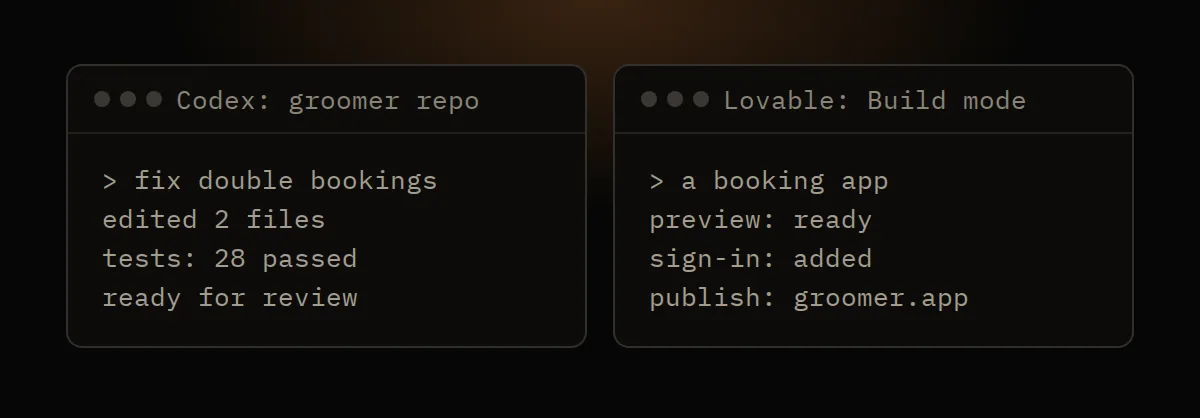
Facts come from OpenAI's and Lovable's documentation, read on 23 November 2026.
Codex and Lovable at a glance
| OpenAI Codex | Lovable | |
|---|---|---|
| What it is | A coding agent for any codebase | A chat-to-app builder for web apps |
| Who it's for | Developers and technical builders | Anyone, including people who don't write code |
| What it builds | Anything: web, mobile, backend, scripts | Web apps and websites |
| Where it runs | ChatGPT desktop app, Codex CLI, IDE extension, Codex cloud, ChatGPT mobile | Browser, desktop app, iOS and Android apps |
| Hosting and backend | Bring your own | Included: hosting plus database, sign-in, storage and functions |
| How you pay | A ChatGPT plan, or an OpenAI API key | Credits, from a free plan up |
What Codex is
Codex is OpenAI's coding agent. You describe an outcome and it reads the code, takes a step, checks the result and keeps going until it's done or needs you. Most people use it in the ChatGPT desktop app by choosing Codex and opening a project folder. It also runs as the open-source Codex CLI, as an extension for VS Code-based editors, as Codex cloud tasks and in the ChatGPT phone app. It reads AGENTS.md files for your conventions and can review a change without editing anything.
Source: Codex app, OpenAI
Source: openai/codex, GitHub
What Lovable is
Lovable is a full-stack AI development platform for building web apps with natural language. You describe what you want and it generates a working app with frontend, backend, database, authentication and integrations, backed by code you can edit. Its project chat has Chat, Plan and Build modes, and it hosts the app with a built-in backend based on Supabase's open-source foundation, covering a database, storage, sign-in, realtime updates and functions.
Source: Welcome to Lovable, Lovable docs
Source: Built-in backend, Lovable docs
The main differences
Starting point and setup
Lovable starts from a sentence and ends with a hosted app; the database, sign-in and hosting are part of the product. Codex starts from a folder or repository: it can create a new project, but you choose the framework, the host and the database, and Codex writes the code and configuration for them.
Range
Lovable builds web apps and websites. Codex works on any software: mobile apps, command-line tools, backends in any language, infrastructure and large existing codebases. A bug in an old payments service is Codex work, not Lovable work.
Code ownership
Lovable stores your project code on its platform; you can download it or two-way sync it with GitHub, GitLab or Bitbucket. Codex works in your own repository from the start, and Codex cloud hands back changes you review as pull requests.
Source: Sync your Lovable project with GitHub, Lovable docs
Where ChatGPT fits
Both connect to ChatGPT. Codex is part of ChatGPT plans. Lovable has a ChatGPT app: tag @Lovable in a ChatGPT conversation to turn an idea you've been discussing into a Lovable project.
Source: Lovable ChatGPT app, Lovable docs
Using Codex and Lovable together
Build the first version in Lovable, turn on GitHub sync, then clone the repository and hand harder changes to Codex; the two-way sync keeps Lovable up to date. Or connect Lovable's MCP server to the Codex CLI so Codex can create Lovable projects, send messages to Lovable, read code and deploy, all from your terminal. It's available on every Lovable plan:
codex mcp add lovable --url https://mcp.lovable.dev
codex mcp login lovable
Source: Lovable MCP server, Lovable docs
Pricing: Codex vs Lovable
| Codex (ChatGPT plans) | Lovable | |
|---|---|---|
| Free | ChatGPT Free and Go: Codex in the desktop app, subject to rollout | Free: unlimited collaborators, 5 lovable.app domains, invite-only publishing |
| Individual | Plus: US$20 a month | Pro: US$25 a month with 100 monthly credits and custom domains |
| Heavy use | Pro: US$100, US$200 or US$500 a month | On-demand credit top-ups |
| Teams | Business: US$20 per user a month billed yearly, or US$25 monthly | Business: US$50 a month with 100 credits, SSO and a team workspace |
Source: Pricing, OpenAI ChatGPT and Codex docs
Source: Pricing, Lovable
Lovable bills credits per message: Plan mode is 1 credit a message, and Build mode varies with the task, from 0.50 credits for a small style change to 1.70 for a landing page with generated images in Lovable's examples. Credits also cover hosting and AI features in your app. Codex comes with your ChatGPT plan's allowance, and hosting is separate.
Which should you choose?
- You don't code and want a working web app live quickly: Lovable.
- You want hosting, a database and sign-in with nothing to set up: Lovable.
- You have an existing codebase, or you're building something other than a web app: Codex.
- You already pay for ChatGPT: Codex is included.
- You want both: start in Lovable, sync to GitHub, and continue with Codex.
Common problems when moving between them
- Codex's changes don't appear in Lovable: check Git sync is connected and that you pushed to the synced branch.
- Lovable credits run down fast: use Plan mode for big changes so you approve the approach before paying for the build.
- Codex can't see the database settings: the built-in backend lives in Lovable, so keep secrets in Lovable's settings, not the repository.
A day with each
With Lovable, you describe a booking app for a dog groomer. A preview appears with a calendar, a booking form and a database; you change the colours, approve a plan for payments and publish to your domain the same day.
With Codex, you open the groomer's existing repository in the ChatGPT desktop app and ask for text reminders the day before each booking. Codex proposes a plan, edits the code, runs the tests and shows you the diff, and a bigger refactor runs in Codex cloud while you're out.
Watching several agents at once
Once an app outgrows its first version, the work often spreads across several Codex and Claude Code sessions. 10u shows every session side by side under the goal it's working toward, marks the ones waiting on you, and lets you answer from one screen on your laptop or phone.

Questions people ask
- What is the difference between Codex and Lovable?
- Codex is OpenAI's coding agent, working inside any codebase. Lovable is a chat-to-app builder that generates and hosts full-stack web apps from plain-language descriptions.
- Is Lovable easier than Codex?
- For a new web app, yes: Lovable includes hosting, a database and sign-in. Codex covers far more kinds of software but expects you to choose a stack and host.
- Can Codex work on a Lovable app?
- Yes. Turn on Git sync with GitHub, GitLab or Bitbucket and work on the repository with Codex; changes sync back to Lovable.
- Can Codex control Lovable?
- Yes. Add Lovable's MCP server to the Codex CLI and it can create projects, message Lovable, inspect code and deploy.
- Is Lovable free?
- Lovable has a free plan with no credit card needed. Pro was US$25 a month with 100 credits on 23 November 2026.