
AI agents for marketing: how marketers use Claude Code to build their own tools
AI agents for marketing come in two kinds. Some are built into the marketing platform you already pay for, and do one job inside it. Others, like Claude Code and Codex, are general-purpose agents that read your files, run steps on their own and build whatever you describe, from a folder of ad variants to a small tool that saves you an hour a week. This guide is about the second kind: what an AI agent is, what marketers actually use Claude Code for, how to set it up so it writes in your brand voice, and the guardrails that keep it from publishing anything you haven't checked.
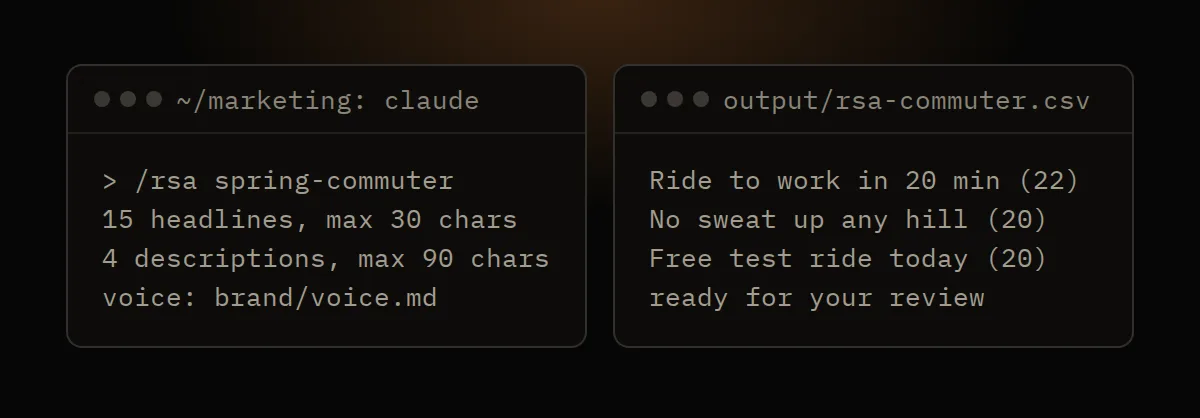
It leans on one well-documented example. Anthropic published how its own growth marketer, who had never written code, used Claude Code to cut a Google Ads copy job from 30 minutes to 30 seconds. The numbers below come from that article and from Anthropic's documentation, read on 23 November 2026.
What an AI agent for marketing actually is
A chatbot answers one message at a time. Automation tools such as Zapier run the same fixed steps every time a trigger fires. An AI agent sits between the two: you give it a goal, and it decides the steps, uses tools to carry them out, checks the result and keeps going until the job is done or it needs you. That is what agentic AI means in practice.
For marketers the difference shows up in work that is repetitive but never quite identical. Refreshing 15 search ad headlines, turning a webinar into posts and emails, or merging three CSV exports into one weekly report all follow a pattern, but the details change each time. A fixed automation breaks on the details. A chatbot needs you to paste everything in and copy everything out. An agent can open the files itself, do the work and save the result where you want it.
| Kind | Examples | Good at | Limits |
|---|---|---|---|
| Chat assistant | Claude, ChatGPT in a browser | Brainstorming, one-off drafts, questions | You move every file in and out by hand |
| Platform agent | Agents inside HubSpot, Salesforce and other marketing suites | Jobs inside that one platform, with its data | Only does what the vendor built; tied to that platform |
| Coding agent | Claude Code, Codex | Working across files and tools, and building small custom tools | Needs a little setup and clear instructions |
| Fixed automation | Zapier, Make, n8n | The same steps every time a trigger fires | Breaks when the input changes shape |
None of these replaces the others. Many teams keep their platform agents for work inside the CRM and use a coding agent for everything that spans tools, files and formats.
Why marketers are using Claude Code
Claude Code is Anthropic's agentic coding tool, which sounds like it has nothing to do with marketing. The reason marketers pick it up is that most marketing work ends in files: CSV exports, spreadsheets, copy decks, HTML emails, landing pages, image variants. Claude Code is built to read, change and create files, run small scripts to check its own work, and connect to other tools. It doesn't need you to code. It needs you to explain the job clearly.
In Anthropic's words, from its growth marketer: you don't need to know how to code, all you need to know is how to explain your challenge and what you're trying to solve. Marketers already know their workflows, feel the friction points and know exactly what a good output looks like. That makes them unusually good at directing an agent.
How Anthropic's own growth marketer uses it
Austin Lau, a growth marketer at Anthropic, had never written a line of code and had to look up how to open a terminal when Claude Code launched. A week after following an internal setup guide, he had built two workflows he uses every day.
A Figma plugin for ad creative variations
Making visual ads meant copying a Figma frame many times, switching to a document to grab each headline, pasting it in, and repeating across ten or more variations and several aspect ratios. He described the problem to Claude Code in plain words and asked it to build a Figma plugin. Claude Code researched how Figma plugins work, read the Figma API documentation, and built a prototype. The plugin took about 45 minutes to an hour to build. It now saves him nearly 30 minutes every time he updates a large batch of creative: he pastes the headlines from a Google Sheet once and the plugin generates every variant.
Google Ads copy with a custom command
Google's responsive search ads need up to 15 headlines and 4 descriptions, with strict character limits, and the copy needs refreshing every few weeks. Austin built a custom slash command, /rsa. Claude Code asks for campaign data, existing copy and keywords, then checks its drafts against skills he wrote for Anthropic's brand voice, product accuracy and Google Ads best practices. He refines the lines with Claude, then it exports the campaign and ad group columns with 15 headlines and 4 descriptions into a CSV ready to upload after a manual review. What used to take 30 minutes per ad takes 30 seconds.
Two details matter more than the speed. The examples and voice rules Claude works from were written with the product marketing and copywriting teams, so human judgment is built in before Claude starts. And every output is reviewed before it goes live.
Across the rest of Anthropic's marketing team
- Influencer marketing writes scripts for influencers and podcasts, freeing more than 100 hours a month.
- Customer marketing drafts case studies in 30 minutes instead of 2.5 hours, saving 10 hours a week.
- Digital marketing built web development workflows that raised team productivity 5x year over year.
- Product marketing uses skills and projects to write launch briefs, saving 5 to 10 hours per launch.
- Partner marketing built self-serve event enablement for sales, cutting trade show prep time by 40%.
Source: How Anthropic uses Claude in marketing, Anthropic
Marketing jobs an AI agent handles well
The pattern in every good use is the same: a repeatable job with clear inputs, a clear output and a rule you could write down for checking it. These are the jobs marketers most often hand to Claude Code.
Ad copy with hard limits
Search and social ads have character limits that are tedious to check by hand. Google's responsive search ads allow headlines of up to 30 characters and descriptions of up to 90. An agent can write the variants, count the characters with a script rather than by eye, and save a CSV in the exact column layout your ad platform imports.
Source: About responsive search ads, Google Ads Help
Weekly and monthly reports
Export the CSVs from each channel into one folder and ask for the report you build by hand every Monday:
Read data/google-ads-oct.csv and data/meta-oct.csv. Build one weekly report:spend, clicks, conversions and cost per conversion by channel and campaign,week on week. Flag any campaign whose cost per conversion rose more than 25%.Save it as output/weekly-report.md with a short summary at the top.
Because the agent writes and runs a small script to do the maths, the numbers come from your data rather than from the model's guess. Keep the script, and next week the report is one short request.
Content repurposing
One long piece of content, such as a webinar, podcast or report, can feed weeks of channels. Give the agent the transcript and the formats you need:
Turn transcripts/webinar-nov.txt into: one blog post of about 1,200 words,five LinkedIn posts, and a 3-email follow-up sequence for attendees.Keep our voice from brand/voice.md and quote the speakers exactly.
SEO and landing pages
Claude Code can build and edit web pages directly, so it suits landing page variants, schema markup, internal links and on-page fixes across a site's files. It can also audit a folder of pages for missing titles, descriptions or alt text and fix them in one pass, with every change shown before it is saved.
Email campaigns
Agents draft sequences, write subject line variants, build HTML emails that match an existing template and check links. Many marketers keep a skill with their email rules, such as preheader length, one call to action and tracking parameters, so every draft follows them.
Data clean-up
Lists from events, forms and CRMs arrive messy: duplicate contacts, mixed date formats, names in capitals, missing fields. An agent can clean, dedupe and reformat a list for import and report exactly what it changed. Strip personal details you don't need before you start, and keep the original file.
Competitor and market research
With web search and fetch tools turned on, an agent can collect competitors' public pages, pricing pages and messaging into a structured comparison, with a source link for every claim. Treat it as a first pass that you verify, not a finished brief.
Small tools that remove busywork
This is the use most marketers don't think of: asking the agent to build the tool rather than do the task. A Figma plugin, a UTM link builder, a script that renames and resizes a folder of creative, a bookmarklet that copies a page's meta tags. Each is a small build for Claude Code and pays back every week after.
Set up Claude Code for marketing work
You need a paid Claude plan that includes Claude Code. The free plan doesn't. Pro is the usual starting point. If the terminal feels unfamiliar, open Claude Desktop, sign in and use the Code tab, which runs the same Claude Code behind a chat box. Then make one folder for your marketing work and keep everything the agent needs in it:
marketing/
  CLAUDE.md                    who we are, audiences, rules
  brand/voice.md               tone, banned words, proof points
  data/                        CSV exports from ads, email, analytics
  .claude/
    skills/
      brand-voice/SKILL.md     checks any copy against the voice
      rsa/SKILL.md             writes Google responsive search ads
  output/                      finished CSVs and drafts for review
Source: Claude Code quickstart, Anthropic
Write a CLAUDE.md with your brand and rules
Claude Code reads a file called CLAUDE.md at the start of every session. For marketers it is where the brand, the audience and the non-negotiable rules live, so you never have to repeat them:
# CLAUDE.md## Who we areAcme Bikes sells e-bikes online in Australia. Main audience: commuters aged 30-50.## VoicePlain, confident, no hype. Read brand/voice.md before writing any copy.## Rules- Never invent statistics, reviews or prices. Use only numbers in data/ or brand/.- Every claim about speed, range or price needs a source in brand/proof.md.- Save drafts to output/, never publish or upload anything yourself.- Ask before reading any file that contains customer emails or phone numbers.
Keep it short and specific. Anthropic suggests under 200 lines, because every line loads every time. Longer material, such as a full voice guide or a list of approved proof points, goes in its own file that CLAUDE.md points to.
Source: Claude Code memory and CLAUDE.md, Anthropic
Turn repeat jobs into skills
A skill is a folder with a SKILL.md file of instructions. Claude Code loads it when a request matches its description, or when you type its name as a slash command, which is how Anthropic's marketer runs /rsa. This is a version of that kind of skill:
---name: rsadescription: Write Google Ads responsive search ad copy from campaign data. Use when asked for RSA headlines or descriptions.---1. Ask for the campaign, ad group, landing page and top keywords if they are missing.2. Read data/ for the last 30 days of ad performance and note which messages won.3. Write 15 headlines of at most 30 characters and 4 descriptions of at most 90.4. Check every line against brand/voice.md and remove any claim we cannot prove.5. Count characters with a script, not by eye, and fix anything over the limit.6. Save output/rsa-<ad group>.csv with Campaign, Ad group, Headline 1-15 and Description 1-4 columns.
Write one skill per job you repeat, and improve it every time the output needs fixing. After a few rounds the first draft is usually close to final. A brand-voice skill that every other skill calls is the most useful one to write first.
Source: Claude Code skills, Anthropic
Connect your tools with MCP
MCP, the Model Context Protocol, is how Claude Code connects to outside tools: databases, design tools, analytics, project boards. Check whether the tools you use publish an official MCP server before you trust a community one, and give it read-only access first. Until you connect anything, exporting CSVs into the data folder works perfectly well.
Source: Connect Claude Code to tools with MCP, Anthropic
What it costs a marketing team
Claude Code comes with a Claude subscription rather than a separate licence. On Anthropic's pricing page on 23 November 2026, Pro cost US$17 a month billed annually or US$20 monthly, and Max, with five times Pro's usage, cost US$100 a month. For a team, a Team plan Standard seat cost US$20 a month billed annually or US$25 monthly, with Premium seats at five times the usage for the heaviest users. Every one of those includes Claude Code; the free plan does not.
Usage resets on a rolling five-hour window and a weekly window, shared with ordinary Claude chat. Marketing jobs are usually light compared with large software projects, so most marketers start on Pro and move up only if they hit the limit regularly. Run /usage inside Claude Code to see how much is left, and clear the conversation between unrelated jobs, which keeps each request smaller.
Compare that with the hours a job takes by hand. If one weekly report takes two hours and an agent brings it to fifteen minutes of review, a single workflow usually covers the subscription within the first month.
Guardrails for AI agents in marketing
An agent that can write files and run commands needs rules. These are the ones that matter most for marketing teams:
- Nothing goes live without a human. Have the agent save drafts and CSVs to an output folder; you upload and publish.
- No invented numbers. Tell it in CLAUDE.md to use only statistics, prices and reviews from your own files, and to say when it doesn't have one.
- Claims need proof. Keep a proof file of approved claims and sources, and have the agent cite it for every claim it makes.
- Protect customer data. Remove names, emails and phone numbers from exports you don't need, and never give an agent a full CRM export to play with.
- Keep permission prompts on while you learn. Claude Code asks before editing files and running commands; read what it is about to do.
- Check the maths. Ask the agent to show the script it used for any report, and spot-check one number against the source.
Legal and platform rules still apply to AI-written copy. Ad platforms reject ads that break their policies regardless of who wrote them, and claims in an ad still need to be true.
Prompts that work for marketing agents
The quality of an agent's work tracks the quality of the brief, exactly as it does with a freelancer. Four things make a marketing prompt work: the goal, the inputs, the rules and the finished format.
- The goal: what the output is for and who reads it. Write ad copy for commuters comparing e-bikes beats write ad copy.
- The inputs: name the files. Read data/meta-oct.csv and brand/voice.md tells the agent exactly where to look instead of guessing.
- The rules: limits and must-nots. At most 30 characters, no prices, no claims that are not in brand/proof.md.
- The format: where to save it and in what shape. Save output/headlines.csv with one headline per row and a character count column.
Ask for options rather than one answer when taste matters, such as ten subject lines rather than the best subject line, and pick from them. Ask the agent to explain its reasoning for a recommendation, then judge the reasoning. And when an output is wrong, say what is wrong in plain words and let it fix the work, rather than editing the file yourself; the fix it learns can go straight into the skill.
For anything bigger than a single draft, start in plan mode. Press Shift+Tab until the bar under the prompt says plan mode on, describe the job, and Claude Code reads your files and proposes a step-by-step plan without changing anything. Correct the plan, then let it work.
Platform agents or your own: how to choose
If a job lives entirely inside one platform and the vendor's agent already does it, use the vendor's agent. It has the data, the permissions and the support. Scoring leads inside a CRM or summarizing support tickets in a help desk are good examples.
Reach for a general-purpose agent like Claude Code when the job crosses tools, when the format has to be exact, or when no vendor has built what you need. Merging three channels into one report, producing upload-ready CSVs, building a plugin for your design tool or turning one transcript into ten formats all fit. The cost is a little setup: a folder, a CLAUDE.md and a skill or two. The payoff is a workflow that does exactly what your team does, and that you own.
Mistakes marketers make with AI agents
- Starting too big. Automate one small, boring step first, as Anthropic's marketer did with a practice calculator app before his real tools.
- Skipping the voice work. Without a voice file and examples, every draft sounds generic and needs heavy editing.
- Trusting the numbers. Ask for the script behind every figure and check one against the source.
- Letting it publish. Agents draft; people approve. Keep uploads and sends manual.
- Never improving the skill. Each correction you make by hand is a rule the skill could have followed. Write it down.
- Running everything in one conversation. Clear between unrelated jobs so the agent isn't confused by last week's campaign.
A first week with an AI agent in marketing
- Day 1: install Claude Code or open the Code tab in Claude Desktop, make a marketing folder and ask it to explain what is in your latest channel export.
- Day 2: write a short CLAUDE.md with your audience, voice and three rules, and add your voice guide as its own file.
- Day 3: hand it one repeat job, such as ad variants or a weekly report, and review every line of the output.
- Day 4: turn that job into a skill, including every fix you made on day 3.
- Day 5: run the skill again on fresh data and time it against doing the job by hand.
- Day 6: ask it to build one small tool that removes a step you hate.
- Day 7: write down the time saved and what you will hand over next.
Measuring whether it is working
Time saved is the easy number: time a job before you hand it to an agent and after. Anthropic's examples are mostly measured that way, from 2.5 hours to 30 minutes for a case study draft. The better number is what you do with the time. More copy tests per month, more channels covered, faster turnaround on a launch. Track one of those for a month, alongside how much of the agent's output you used without heavy edits.
Claude Code or Codex for marketers
Both are general-purpose coding agents that work on files in a folder, and either can do the jobs on this page. Claude Code has the documented marketing case study, skills and slash commands that suit repeat marketing jobs, and the Code tab in Claude Desktop for people who prefer not to use a terminal. Codex is OpenAI's equivalent and fits teams already on a ChatGPT plan. Pick the one your team already pays for, and switch only if it can't do a job you need.
Running several marketing agents at once
Once the first workflow works, most marketers run more than one agent: one drafting ads, one building the weekly report, one repurposing last week's webinar. Each one stops when it needs an answer. 10u is an AI coding agent dashboard that shows every Claude Code and Codex session side by side, each in its real terminal, marked Needs you, Working, Waiting or Parked, so none of them sits waiting on a question while you are in a meeting. They do the building. You decide what gets built.

Questions people ask
- What are AI agents for marketing?
- AI tools that take a marketing goal, decide the steps and carry them out with tools, such as writing ad variants, building a report from CSV exports or repurposing a webinar, then save the result for you to review.
- Can marketers use Claude Code without coding?
- Yes. Anthropic's own growth marketer had never written code and built a Figma plugin and a Google Ads copy workflow in his first week. You describe the job in plain words and review what it produces.
- What do marketers use Claude Code for?
- Ad copy with character limits, creative variants, weekly reports from channel exports, content repurposing, landing pages, email drafts, list clean-up and small tools that remove repetitive work.
- How do I keep an AI agent on brand?
- Put your audience, voice and rules in CLAUDE.md, keep a voice guide and approved claims in their own files, and write a brand-voice skill that checks every draft.
- Is it safe to give an AI agent marketing data?
- Give it only what the job needs. Remove personal details from exports, keep originals, leave permission prompts on and never let it publish or upload without a human check.
- Do I need a paid plan to use Claude Code for marketing?
- Yes. The free Claude plan doesn't include Claude Code. Pro is the usual starting point, and Team plans include it for every seat.