
Claude Code vs Replit: Anthropic's coding agent or an all-in-one cloud app builder?
Claude Code is Anthropic's coding agent: it works in your own codebase on your own computer, or in the cloud from the web and desktop app, reading files, editing code and running commands with Claude models. Replit is a cloud platform where Replit Agent builds apps, websites and native mobile apps from a description, then runs, hosts and publishes them, with databases and storage built in, all in a browser. Choose Replit if you want to go from idea to a live app with nothing installed and nothing to host yourself. Choose Claude Code if you want an agent working in your own repository, with your own tools, hosting and review process.
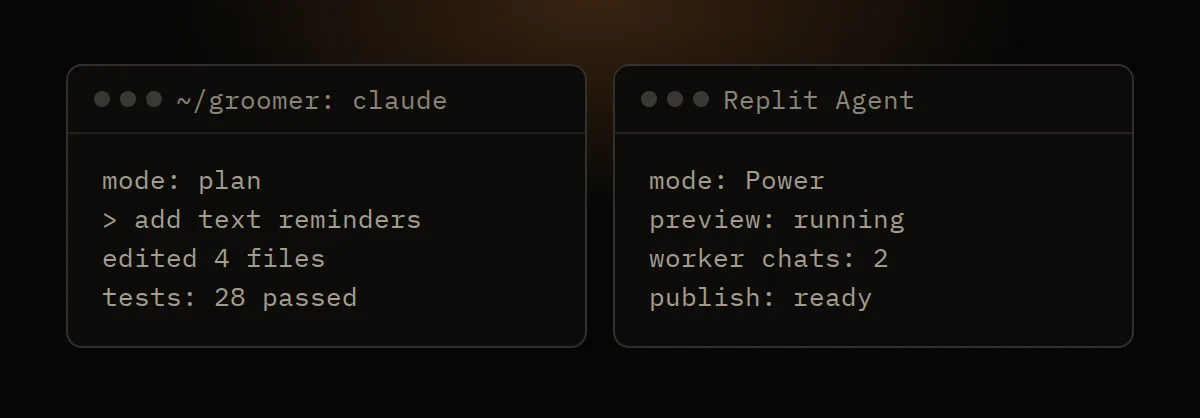
Facts come from Anthropic's and Replit's documentation, read on 23 November 2026.
Claude Code and Replit at a glance
| Claude Code | Replit | |
|---|---|---|
| What it is | A coding agent | A cloud platform with Replit Agent, an editor, hosting and databases |
| Where your code runs | Your computer, or Anthropic's cloud sessions | Replit's cloud development environment |
| Where it runs | Terminal, VS Code and JetBrains, desktop app, web | Browser, plus Replit's apps |
| What it builds | Anything in your repository | Web apps, websites, native iOS and Android apps, and more |
| Hosting | Bring your own | Built in: publishing, databases and app storage |
| Models | Claude models you pick | Free, Power and Max modes; Replit routes the model |
| Existing repositories | Yes, any | Yes, from GitHub or GitLab, with pull requests |
| Free option | No | Starter plan, free |
What Replit is
Replit calls itself an AI platform for turning ideas into real outcomes: describe what you want in plain language, then create, launch and grow apps, sites, tools and businesses in one place. You talk to Replit Agent in a chat; it writes the code, runs the app in a cloud environment and shows a live preview you test and refine. When it's ready, you publish from the same place, with databases and storage billed as you use them. Replit also has Replit Design for generating and refining design frames, voice prompts, skills, connectors to other services and routines that run on a schedule.
Source: Publishing, Replit docs
Replit Agent has three modes. Free Mode covers everyday chat and building, with Replit choosing the model and an allowance that depends on your plan. Power Mode balances speed and capability for most work, and Max Mode is for complex work and larger codebases; both draw on monthly credits, and Replit tells you before a request moves from Free Mode into a paid mode.
Source: Select the right Agent Mode, Replit docs
Replit can also build native mobile apps for iOS and Android, and its guides walk through a mobile game built with Agent and a team building in parallel.
Source: Start your first mobile app, Replit docs
Replit on existing code
Replit isn't only for new apps. Connect GitHub or GitLab and Replit can explain how a feature works, fix bugs, build features using your existing patterns, run a development preview in a cloud sandbox and open a pull request for your team to review. A preview is not your live app, and opening a pull request doesn't merge or deploy it. For bigger jobs, Replit hands independent tasks to worker chats that run in parallel while your main chat brings the results together.
Source: Code with Replit, Replit docs
Source: Work with a team of agents, Replit docs
What Claude Code is
Claude Code is Anthropic's agentic coding tool. It reads your codebase, edits files, runs commands and works with your development tools, in any terminal, in VS Code and JetBrains, in a desktop app that runs several sessions side by side, and on the web with cloud sessions.
- Plan mode has Claude research and propose a plan before editing.
- Permission modes run from Manual to Auto, where a classifier blocks risky actions instead of asking.
- Subagents handle side jobs in their own context; agent teams coordinate several sessions through a shared task list.
- Hooks, skills, plugins and MCP servers connect it to your own tools and checks.
- CLAUDE.md files hold your project's rules and commands, loaded every session.
Source: Claude Code overview, Anthropic
The main differences
Where the work happens
Replit runs everything in its cloud: the editor, the app, the preview, the database and the published site. You need only a browser, which is why non-developers and teams without a local setup like it. Claude Code usually runs on your own computer, against your own files and tools, so it can use anything installed there: your test suite, your local database, your company's internal tools. It also offers cloud sessions from the web when you'd rather not use your own machine.
Hosting and data
Replit publishes your app and hosts its database and storage, billed by usage alongside your plan. Claude Code doesn't host anything: it writes the code and the configuration, and you deploy to whatever host you already use. That's more setup, but your production stays wherever your team wants it.
Models and control
Claude Code lets you choose the Claude model and effort level. Replit routes the model for you in Free Mode and gives you a choice of capability through Power and Max modes rather than by model name. Claude Code also gives you finer control over what the agent may do: permission modes, allow, ask and deny rules, a sandbox for shell commands, and hooks that run your own checks.
Source: Choose a permission mode, Anthropic
Who it's for
Replit is aimed at founders, product managers, designers, operations teams and engineers alike, and its repository features let non-engineers propose changes that engineers review. Claude Code is aimed at people comfortable in a terminal or editor, though its desktop app makes it easier to start.
Automation
Replit's routines run Agent on a schedule in Power or Max Mode, each with a per-run budget, for jobs such as weekly release notes or monitoring a competitor's pricing page. Claude Code automates through GitHub Actions for reviews and issue triage, its non-interactive mode in scripts and CI, and scheduled routines, all running against your own repository.
Moving projects in
Replit can import projects from GitHub and from other app builders such as Lovable and Bolt, then carry on building with Agent. Claude Code needs no import: it works on whatever folder you open, whichever tool created it.
Security and access
Replit works in a cloud sandbox with the access you authorize. It reaches GitHub and GitLab through its own Git provider proxy, keeping repository credentials out of the sandbox, and Replit notes that sandbox isolation doesn't reduce the permissions of credentials you hand it, so give development access with the smallest scope that works. Claude Code runs with your own user's permissions on your machine, so its permission modes and sandbox are your main guardrails, along with reviewing every diff.
Source: Security for repository contributions, Replit docs
Pricing: Claude Code vs Replit
| Claude Code | Replit | |
|---|---|---|
| Free | No free plan | Starter: free, with Free Mode limits |
| Individual | Pro: US$17 a month billed annually or US$20 monthly | Core: US$20 a month (US$18 billed annually), up to 30 hours of Free Mode chat and US$20 towards more powerful models |
| Heavy use | Max: US$100 a month; Ultra: US$200 a month | Pro: from US$100 a month (US$90 billed annually), with tiers up to US$2,000 a month |
| Hosting | Your own host, billed separately | Publishing, databases and storage billed by usage |
| Enterprise | US$20 per seat a month plus usage at API rates | Custom: SSO, SCIM, audit logs, private networking |
Source: Plans and pricing, Claude
Source: Pricing, Replit
The comparison isn't like for like. A Claude plan pays for the agent only. A Replit plan pays for the agent and an allowance towards the models, and hosting the app adds usage charges on top. For a hobby app, Replit's all-in-one bill is usually simpler; for a team with existing hosting, Claude Code plus that hosting is usually cheaper and more flexible.
Which should you choose?
- You want an app live without installing anything or setting up hosting: Replit.
- You want a native mobile app built and run in the cloud from a chat: Replit.
- You work in your own repository with your own tools and hosting: Claude Code.
- You want fine control over the model, permissions and checks: Claude Code.
- Your non-engineers want to propose code changes that engineers review: Replit's repository features, or Claude Code in GitHub Actions.
Getting started with each
Replit: sign up, type a description of the app on the home screen, and let Agent build it in Free Mode. Test it in the preview, ask for changes in the chat, and publish when you're happy. To work on existing code, connect GitHub or GitLab from the repositories page and open a chat on the repository.
Claude Code: install it, run claude in your project folder or open the desktop app, and sign in with your Claude account. Run /init to create a CLAUDE.md file describing the project, then describe your first task and review the plan before letting it edit.
Using Claude Code and Replit together
- Keep the code in a GitHub or GitLab repository you control, and connect it to Replit.
- Use Replit to explore the code, run previews in the cloud and let teammates propose changes as pull requests.
- Use Claude Code locally for larger refactors, tests and work that needs your own tools.
- Keep the main branch as the meeting point, and review every pull request the same way, whichever agent made it.
Who each one suits
Replit suits founders testing an idea, people who don't want to install anything, teams that want non-engineers proposing changes, and anyone who'd rather not think about hosting. Claude Code suits developers with an existing codebase and toolchain, teams with their own hosting and review process, and anyone who wants detailed control over what the agent may run. Plenty of teams use both: Replit for quick prototypes and previews, Claude Code for the production codebase.
Common problems and fixes
- Replit credits run down faster than expected: stay in Free Mode for everyday work and switch to Power or Max only for hard problems.
- Claude Code can't reach a service the Replit app used: Replit's built-in database and secrets live in Replit, so set up the same services where you run the code.
- Two agents changed the same files: keep each agent on its own branch or git worktree and merge through pull requests.
- A Replit preview works but production doesn't: a preview isn't your live app, so test the published version before announcing it.
A day with each
With Replit, you open a browser, describe a booking app for a dog groomer and watch Agent build it in Free Mode. You test it in the preview, switch to Power Mode to add payments, ask for two worker chats to check the copy and accessibility in parallel, and publish before lunch.
With Claude Code, you open the groomer's existing repository on your laptop, ask Claude to plan text reminders, approve the plan, let it write the code and tests against your local database, review the diff and deploy to the host you already use.
Watching several agents at once
When Claude Code and Codex sessions run across several machines and projects, the hard part is knowing which one is waiting for you. 10u shows every session side by side under the goal it's working toward, marks the ones waiting on you, and lets you answer from one screen on your laptop or phone.

Questions people ask
- What is the difference between Claude Code and Replit?
- Claude Code is Anthropic's coding agent, usually working in your own repository on your computer. Replit is a cloud platform where Replit Agent builds, runs, hosts and publishes apps, with databases built in.
- Is Replit good for beginners?
- Yes. Replit needs only a browser, and Agent builds, previews and publishes the app for you. Claude Code suits people comfortable with a terminal or editor.
- Can Replit work on my existing GitHub repository?
- Yes. Connect GitHub or GitLab and Replit can explain code, make changes, run a preview in a cloud sandbox and open a pull request.
- Which models does Replit Agent use?
- Replit routes the model for you. Free Mode uses intelligent routing; Power and Max modes give more capability and use monthly credits.
- Is Replit free?
- Replit's Starter plan is free with Free Mode limits. Core was US$20 a month on 23 November 2026.
- Can I use Claude Code and Replit on the same project?
- Yes. Keep the code in a GitHub or GitLab repository, connect it to Replit, and work on it locally with Claude Code, with both proposing changes as pull requests.