
Codex vs Kiro: OpenAI's coding agent or a spec-driven agent with many models?
Codex is OpenAI's coding agent, included with ChatGPT plans, running in the ChatGPT desktop app, a terminal CLI, editors, the cloud and your phone with OpenAI models. Kiro is an AI coding agent built around one shared harness that runs the same agent in the Kiro IDE, the Kiro CLI, a web app, mobile apps and other editors, with models from Anthropic, OpenAI and others paid for in credits. Kiro's signature feature is specs: requirements, design and task files the agent writes before it builds. Choose Codex if you already pay for ChatGPT and want a fast agent you steer; choose Kiro if you want structured, spec-first planning and a choice of models.
Facts come from OpenAI's and Kiro's documentation, read on 23 November 2026.
Codex and Kiro at a glance
| OpenAI Codex | Kiro | |
|---|---|---|
| Surfaces | ChatGPT desktop app, Codex CLI, IDE extension, Codex cloud, ChatGPT mobile | Kiro IDE, Kiro for VS Code, Kiro CLI, web, Android and iOS, ACP editors such as JetBrains and Zed |
| Models | OpenAI models | Claude, GPT, Grok, Kimi, DeepSeek, Qwen and others, or Auto routing |
| How you pay | A ChatGPT plan, or an OpenAI API key | Credits on five tiers from Free to Power, with model multipliers |
| Planning | Ask for a plan before edits | Specs: requirements.md, design.md and tasks.md, plus plan mode |
| Project instructions | AGENTS.md | Steering files in .kiro/steering/, and AGENTS.md |
| Permissions | Sandbox modes plus approval policies | permissions.yaml rules: deny, ask, allow, evaluate |
| Cloud | Codex cloud tasks | Cloud sessions on web and mobile that deliver pull requests |
| Open source | Codex CLI, Apache 2.0 | No |
What Codex is
Codex is OpenAI's coding agent. You describe an outcome and it reads the code, takes a step, checks the result and keeps going until it's done or needs you. Most people use it in the ChatGPT desktop app by choosing Codex and opening a project folder; it also runs as the open-source Codex CLI, as an extension for VS Code-based editors, in Codex cloud and in the ChatGPT phone app. It reads AGENTS.md files for your conventions, uses skills, plugins and MCP servers, and can review a change and report findings without editing anything.
Source: Codex app, OpenAI
Source: openai/codex, GitHub
What Kiro is
Kiro describes itself as one agent available everywhere you work. A unified agent harness runs the conversation, executes tools, manages context, checks permissions and talks to model providers, and every Kiro surface connects to it through the open Agent Client Protocol, which is also how JetBrains IDEs and Zed can use Kiro as their agent. In the IDE and CLI the harness runs on your machine; on web and mobile it runs in a managed cloud sandbox that clones your repository and delivers changes as pull requests.
Source: How Kiro works, Kiro docs
Specs
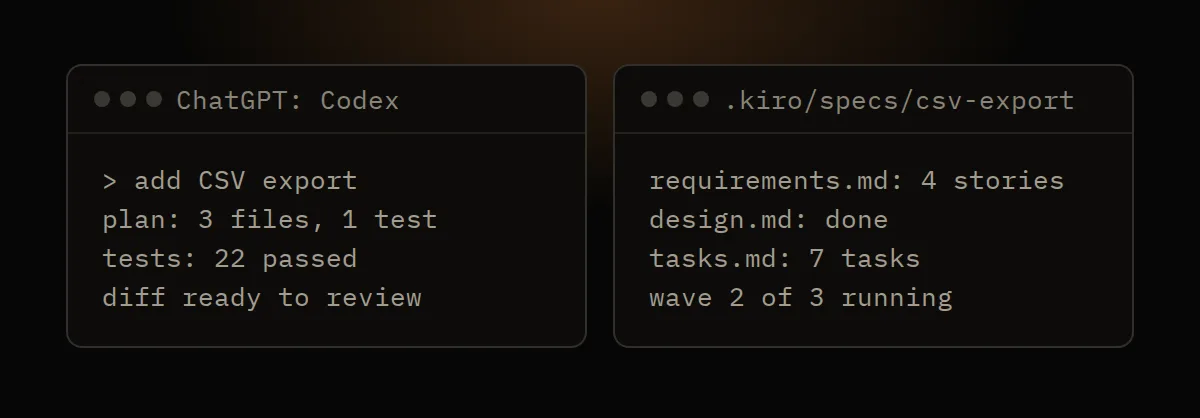
A Kiro spec turns an idea into three files in .kiro/specs/<name>/: requirements.md, or bugfix.md for a bug, with user stories and acceptance criteria; design.md, with architecture, diagrams, error handling and testing strategy; and tasks.md, a list of trackable tasks. When you run all the tasks, Kiro builds a dependency graph and runs independent tasks at the same time in waves.
Source: Specs, Kiro docs
The main differences
Planning style
Kiro makes planning a file you keep: requirements, design and tasks written before code and kept in the repository. Codex plans in the conversation: ask it for a plan, read it, push back, then let it build, and ask it to write a design document into the repository if you want one kept. Teams that want a written trail from requirement to task tend to prefer Kiro; people who want to move quickly and steer as they go tend to prefer Codex.
Models and cost
Codex runs OpenAI's models on your ChatGPT plan's allowance. Kiro offers many providers' models and charges credits with a multiplier per model relative to Auto at 1.0x, so a task that costs 10 credits on Auto costs 20 on Claude Opus 5.5. Kiro's tiers run from Free with 50 credits to Power with 10,000, and paid tiers can buy add-on credits.
Source: Models, Kiro docs
Source: Billing, Kiro docs
Permissions and safety
Codex's sandbox decides what is technically possible, read-only, workspace-write or full access, and its approval policy decides when it asks. Kiro checks every tool call against rules in permissions.yaml, where deny beats ask and ask beats allow, plus ignore patterns, and runs a local command sandbox on your machine or a managed cloud sandbox on web.
Source: Sandboxing, OpenAI Codex docs
Source: Permissions, Kiro docs
Project instructions
Codex reads AGENTS.md. Kiro reads steering files in .kiro/steering/, can generate product.md, tech.md and structure.md foundation files, and also reads AGENTS.md. Keeping shared rules in AGENTS.md lets both agents follow them.
Source: AGENTS.md, OpenAI Codex docs
Source: Steering, Kiro docs
Pricing: Codex vs Kiro
| Codex (ChatGPT plans) | Kiro | |
|---|---|---|
| Free | ChatGPT Free and Go: Codex in the desktop app, subject to rollout | Free: 50 credits |
| Individual | Plus: US$20 a month | Pro: 1,000 credits, or Pro+: 2,000 |
| Heavy use | Pro: US$100, US$200 or US$500 a month | Pro Max: 5,000 credits, or Power: 10,000 |
| Teams | Business: US$20 per user a month billed yearly, or US$25 monthly | Organisation sign-in available; see Kiro billing |
| How usage is measured | Allowance per five-hour window and week, varying by model | Credits used fractionally, with model multipliers |
Source: Pricing, OpenAI ChatGPT and Codex docs
Check Kiro's billing page for the current price of each tier. The practical comparison is how far a month goes on your real tasks: on Kiro that depends heavily on which model you choose, on Codex on which OpenAI model and whether tasks run locally or in the cloud.
Which should you choose?
- You already pay for ChatGPT: Codex, at no extra cost.
- You want written requirements, design and task files before any code: Kiro.
- You want to pick between Claude, GPT and open models per task: Kiro.
- You want an open-source terminal agent you can inspect and script: the Codex CLI.
- You want one agent across a desktop app, terminal, editor, cloud and phone on one subscription: Codex.
- You use JetBrains or Zed and want an agent through the Agent Client Protocol: Kiro.
Using Codex and Kiro together
- Write a Kiro spec for a large feature, then hand individual tasks from tasks.md to Codex if you prefer its speed for implementation.
- Keep conventions in AGENTS.md, which both read.
- Give each agent its own git worktree when they work at the same time.
- Review every diff or pull request the same way, whichever agent produced it.
A day with each
With Codex, you open the ChatGPT desktop app, choose Codex and ask it to add CSV export to the orders page. It proposes a plan in a few lines, you agree, and it edits three files, runs the tests and shows you the diff. A larger refactor goes to Codex cloud while you're in a meeting.
With Kiro, you describe the same feature and ask for a spec. Kiro writes requirements with acceptance criteria, a design covering errors and tests, and a task list. You edit the requirements, approve, and run all tasks; independent ones run in parallel waves, and you watch them complete in the IDE.
Watching several agents at once
When Codex, Kiro and Claude Code are all running on one project, the hard part is knowing which agent is waiting for you. 10u shows every Codex and Claude Code session side by side under the goal it's working toward, marks the ones waiting on you, and lets you answer from one screen on your laptop or phone.

Questions people ask
- What is the difference between Codex and Kiro?
- Codex is OpenAI's coding agent on ChatGPT plans, running in a desktop app, terminal, editor, cloud and phone. Kiro is a spec-driven agent with its own IDE, CLI, web and mobile apps, offering many providers' models paid for in credits.
- Does Kiro use OpenAI models?
- Yes. Kiro offers GPT models alongside Claude, Grok, Kimi, DeepSeek, Qwen and others, each with its own credit multiplier.
- What are Kiro specs?
- Three files Kiro writes before building: requirements with acceptance criteria, a design, and a task list. Running the tasks executes independent ones in parallel waves.
- Is Kiro free?
- Kiro has a Free tier with 50 credits. Paid tiers run from Pro with 1,000 credits to Power with 10,000.
- Can Codex write specs like Kiro?
- Codex has no spec file format of its own, but you can ask it for a plan before it edits, or to write requirements and design documents into the repository first.
- Can I use Codex and Kiro together?
- Yes. Keep shared rules in AGENTS.md, give each agent its own worktree, and review all changes the same way.