
OpenAI Codex alternatives: 15 coding agents compared
The main OpenAI Codex alternatives are Claude Code, Cursor, GitHub Copilot, OpenCode, Google's Antigravity CLI and Gemini CLI, and Aider, with Amp, Kiro, Cline, Roo Code, goose, Zed, Warp, Jules and Devin Desktop close behind. Claude Code is the closest match: Anthropic's full coding agent for the terminal, editor, desktop and web. Cursor and Copilot put AI inside your editor. OpenCode and Aider are open source and work with many providers, and OpenCode can even sign in with the ChatGPT plan you use for Codex.
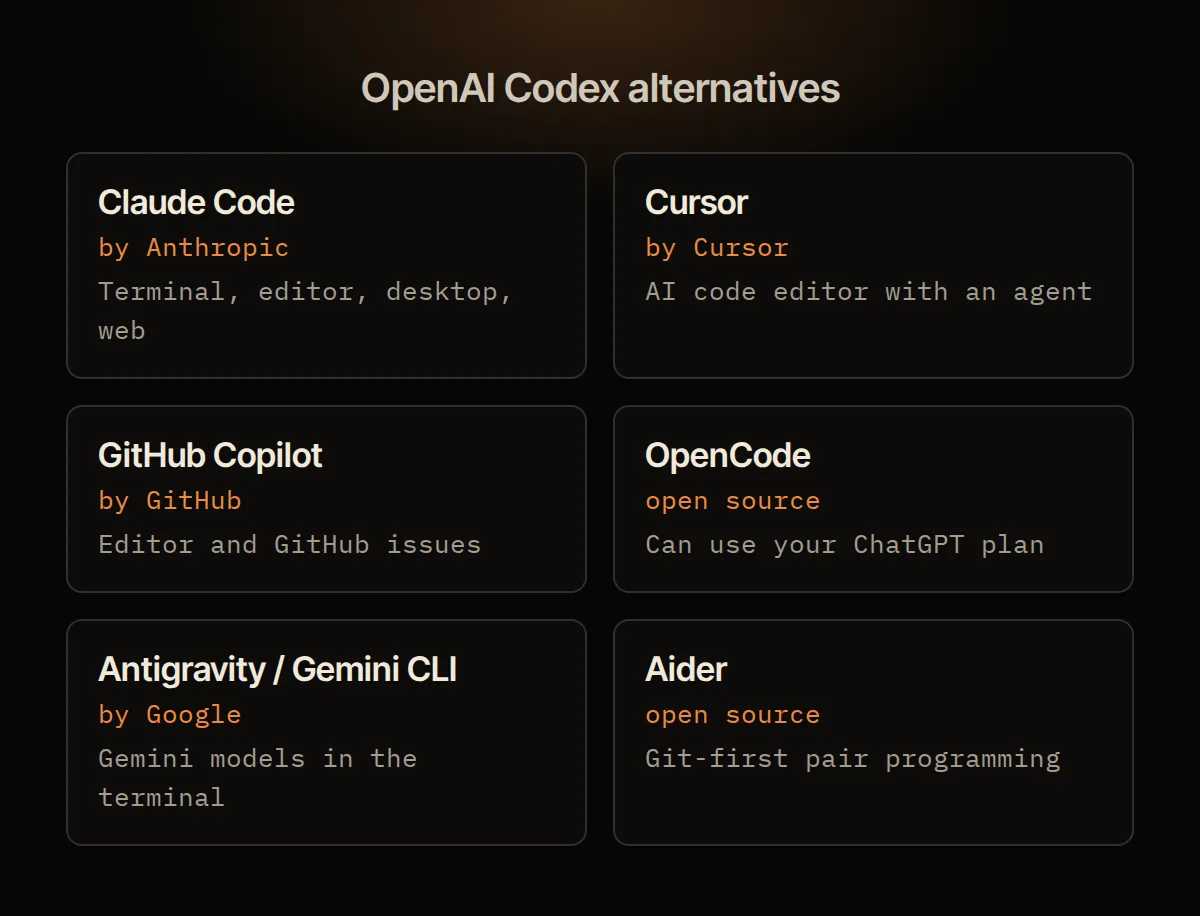
Codex alternatives at a glance
| Tool | Made by | What it is | Models |
|---|---|---|---|
| Claude Code | Anthropic | Coding agent in the terminal, VS Code and JetBrains, desktop app and web | Claude models |
| Cursor | Cursor | AI code editor with an agent, a CLI and cloud agents | Several providers plus its own |
| GitHub Copilot | GitHub | Assistant in your editor and on GitHub, with a coding agent | Several providers |
| OpenCode | OpenCode team | Open source terminal agent, desktop app and web | Many providers, including a ChatGPT plan |
| Antigravity CLI / Gemini CLI | Google's command-line coding agents | Gemini models | |
| Aider | Aider project | Open source pair programming in your terminal | Almost any, including local |
| Amp | Amp | Coding agent that runs threads on its own machines | Several, picked per job; ChatGPT sign-in |
| Kiro | Kiro | Spec-driven agent in an IDE, VS Code, CLI, web and mobile | Not covered here |
| Cline | Cline | Open source agent in VS Code, JetBrains, desktop and CLI | Many providers |
| Roo Code | Roo Code | Open source editor agent with modes | Many providers |
| goose | Agentic AI Foundation | Open source general agent: desktop and CLI | 85+ providers and local models |
| Zed | Zed | Editor that hosts its own agent and others, including Codex | Hosted, your keys, local |
| Warp | Warp | Agentic terminal with cloud agents | Not covered here |
| Jules | Experimental agent that works on GitHub repositories | Not covered here | |
| Devin Desktop | Devin | AI IDE with a local agent shared with Devin CLI | Not covered here |
Every fact on this page comes from each tool's own documentation or README, read on 22 November 2026, with a link to the source in each section. Prices are left out because they change often.
Why people look beyond Codex
- Usage limits. Codex usage is counted per five-hour period on Plus and Business plans, and weekly limits may apply, so heavy users want a second plan.
- A different model. Some work goes better with Claude, Gemini or an open model.
- Editor-first work. Some people want suggestions and an agent inside the editor.
- Open source and local models. Some teams need an agent they can change or point at their own models.
- What the company already pays for, such as GitHub Copilot or Google Cloud.
1. Claude Code
Claude Code is Anthropic's agentic coding tool and the closest alternative to Codex. It reads your codebase, edits files, runs commands and works with your development tools, in the terminal, VS Code and JetBrains, a desktop app that runs several sessions side by side, and the web. For bigger jobs it has subagents, experimental agent teams where a lead session coordinates teammates through a shared task list, and agent view for watching many background sessions. Hooks, skills, plugins and MCP servers let you extend it.
Like Codex, it reads project instructions: CLAUDE.md, or your existing AGENTS.md when there is no CLAUDE.md. You use it with a Claude plan or an Anthropic Console account. See our full comparison of Claude Code vs Codex.
Source: Claude Code overview, Anthropic
Source: Orchestrate teams of Claude Code sessions, Anthropic
2. Cursor
Cursor is an AI code editor. Its Agent works beside your code, completes tasks on its own, runs terminal commands and edits files, with models from Anthropic, OpenAI, Google, xAI and Cursor's own. Its Agents Window runs agents in parallel with worktrees, cloud agents run in their own virtual machines, and a CLI covers the terminal.
Choose Cursor if you want an editor with AI throughout and the freedom to switch models, including OpenAI's.
Source: Cursor Agent, Cursor docs
3. GitHub Copilot
GitHub Copilot suggests code as you type, answers questions, reviews pull requests and takes on tasks from issues, returning a pull request. It runs agent work in a cloud sandbox, on GitHub Actions or in a remote environment. It can also run OpenAI's Codex agent and Anthropic's Claude agent as third-party agents, in public preview, on a Copilot subscription. There is a free plan.
Choose Copilot if your team works in GitHub issues and pull requests or already pays for Copilot.
Source: About GitHub Copilot, GitHub Docs
4. OpenCode
OpenCode is an open source coding agent for the terminal, desktop and web. It connects to many providers, and for Codex users one detail stands out: you can connect OpenAI and choose Sign in with ChatGPT to use your Plus or Pro plan. Usage counts against that plan, and OpenCode caps the context window to Codex's defaults so your allowance is used at a similar rate. It also connects to GitHub Copilot, Anthropic and its own OpenCode Go subscription.
Choose OpenCode if you want a different, open source agent while keeping your ChatGPT plan, or to switch between providers.
Source: OpenCode providers, OpenCode docs
5. Google's Antigravity CLI and Gemini CLI
Google's Gemini CLI README says free individual access and Google AI Pro and Ultra plans moved to the Antigravity CLI on 18 June 2026. It describes Antigravity CLI as an interactive multi-agent coding terminal for newer Gemini models, and Gemini CLI as an open source terminal agent now maintained for organisations on Gemini Code Assist Standard, Enterprise or Code Assist for GitHub.
Choose Antigravity CLI for Gemini models on a personal account, and Gemini CLI if your organisation runs Gemini Code Assist on Google Cloud.
Source: Gemini CLI README, Google
6. Aider
Aider is open source pair programming in your terminal. It connects to almost any model, including local models, maps your codebase so it copes with large projects, commits every change to Git with a sensible message, and can lint and test after each change and fix what fails.
Choose Aider for a lightweight, Git-first agent or for local models.
Source: Aider README
7. Amp
Amp describes itself as a coding agent and development environment built for the frontier. It uses several models, each for what it does best, rather than one. Each thread can run in an orb, a machine Amp sets up with your code, tools and plugins, so you can send a prompt, close your laptop and let it keep working. You can start an orb from an iPhone, check it from a Mac and follow up in the terminal, and the apps tell you when a thread is ready for your next message. Threads can be saved and shared, and you can sign in with a ChatGPT Plus or Pro plan to use OpenAI models in Amp.
Choose Amp if you want an agent that picks the model for you and runs work on its own machines.
Source: Amp manual
8. Kiro
Kiro is an AI development environment with one agent behind every surface: a desktop IDE, a VS Code extension, a CLI with a headless mode for CI, a web agent that plans, implements and opens pull requests across repositories, and a mobile app for checking tasks and reviewing pull requests. Its configuration lives in a .kiro folder shared by all of them. It is built around specs, steering files, hooks, custom agents, skills and MCP, with checkpoints so you can rewind.
Choose Kiro if you like to plan from a written spec before the agent builds, and want the same setup in the editor, terminal and browser.
Source: Kiro docs
9. Cline
Cline is an open source coding agent that runs in several places: a CLI with interactive chat or fully headless runs for CI and scripts, a desktop app for macOS and Windows that can schedule routines, a VS Code extension and a JetBrains plugin. In the editor it creates files, runs commands, browses the web and uses tools, with your approval at each step. An SDK lets you build your own agents on the same engine.
Choose Cline if you want an open source agent inside VS Code or JetBrains that asks before it acts.
Source: Cline README
10. Roo Code
Roo Code is an open source AI assistant for your editor built around modes: Code for everyday edits, Architect for planning systems and migrations, Ask for quick answers, Debug for tracing problems, and custom modes you define for your team. It generates code from descriptions, refactors, writes documentation, answers questions about your codebase and uses MCP servers.
Choose Roo Code if you want to switch the agent between planning, building and debugging roles in your editor.
Source: Roo Code README
11. goose
goose is an open source, general-purpose agent for coding, research, writing, automation and data analysis, now part of the Agentic AI Foundation at the Linux Foundation. It has a desktop app for macOS, Linux and Windows and a CLI. It connects tools and data through MCP, can load local models directly without a separate model server, and connects to over 85 providers, including Anthropic, OpenAI, Gemini, OpenRouter and Amazon Bedrock.
Choose goose if you want an open source agent that is not only for code and works with local models.
Source: goose README
12. Zed
Zed is a code editor with three ways to run agents: its own Zed Agent, which can use hosted models, your provider API keys, supported subscriptions or local models; external agents connected through the Agent Client Protocol; and terminal threads that run an agent CLI right inside the editor. The threads sidebar runs several agent threads at once, each with a different agent and project, so Claude Code or Codex can run inside Zed beside its own agent.
Choose Zed if you want a fast editor that can host several agents, including the ones you already use.
Source: AI in Zed, Zed docs
13. Warp
Warp calls itself an open source agentic development environment. Its desktop terminal runs commands, edits code and starts and steers coding agents in a local checkout, and the Warp Agent can investigate issues, edit code, run commands and do multi-step work, in Warp or from its CLI in any terminal. Its automation platform runs cloud agents from triggers, schedules, integrations and APIs for jobs such as issue triage and pull request review.
Choose Warp if you want a modern terminal with an agent built in and cloud agents for background jobs.
Source: Warp overview, Warp docs
14. Jules
Jules is Google's experimental coding agent for fixing bugs, adding documentation and building features. You sign in with a Google account, connect GitHub and choose the repositories it may use. It works through a task on its own, so you can move on while it runs, and it supports scheduled and suggested tasks, planning and code review.
Choose Jules if you want a Google agent that works on GitHub repositories without anything installed on your computer.
Source: Getting started, Jules docs
15. Devin Desktop
Devin Desktop is an AI IDE for Mac, Windows and Linux that can import your VS Code or Cursor settings. Its local agent, Devin Local, shares its harness with Devin CLI and runs on your machine. It reads rules and AGENTS.md files, connects MCP servers and has workflows for automating repeated tasks. The Windsurf docs address now opens Devin Desktop's documentation.
Choose Devin Desktop if you want an AI-first editor and an agent you can also run from the terminal.
Source: Welcome to Devin Desktop, Devin docs
Which Codex alternative to pick
| If you want... | Look at |
|---|---|
| A full agent from another company | Claude Code |
| To keep using your ChatGPT plan in a different agent | OpenCode |
| AI built into your editor | Cursor or GitHub Copilot |
| A free plan to start | GitHub Copilot |
| Open source or local models | OpenCode or Aider |
| Google's models | Antigravity CLI or Gemini CLI |
| Another agent that can use your ChatGPT plan | OpenCode or Amp |
| Agents that keep working while your computer is off | Amp, Kiro's web agent, Warp, Jules or Claude Code cloud sessions |
| A spec written before the build | Kiro |
| Codex inside an editor with other agents | Zed |
Trying an alternative without losing your Codex setup
- Keep your rules in AGENTS.md. Claude Code reads it when there is no CLAUDE.md, and OpenCode reads it too.
- Give the new agent one real task in its own Git worktree, so it cannot clash with Codex's work.
- Compare on the same task: tests passing, how much you corrected, and how quickly each used its allowance.
- Run both for a week before deciding. Many people keep both.
Source: Codex CLI, OpenAI
Codex and Claude Code side by side
The most popular answer to "what should I use instead of Codex" is Claude Code alongside it. Two plans mean one carries on when the other's limit is reached, two models catch different mistakes, and each agent can review the other's work. The hard part is keeping track of both: each lives in its own terminal or app, and an agent waiting for your answer can sit unnoticed.
10u is an AI coding agent dashboard built for running both. It shows every Codex and Claude Code session side by side, each in its real terminal, marked Needs you, Working, Waiting or Parked, with the one waiting on you on top. It runs on the subscriptions you already have. They do the building. You decide what gets built.

Questions people ask
- What is the best alternative to OpenAI Codex?
- Claude Code is the closest match: Anthropic's full coding agent for the terminal, editor, desktop and web. Cursor and GitHub Copilot suit editor-first work, and OpenCode and Aider are open source.
- Can I use my ChatGPT plan in another coding agent?
- Yes. OpenCode can connect OpenAI with Sign in with ChatGPT, using a Plus or Pro plan instead of an API key.
- Is there a free alternative to Codex?
- GitHub Copilot has a free plan. OpenCode and Aider are open source, though you pay for the models you connect unless you run local ones.
- Can I run Codex and Claude Code together?
- Yes. Give each its own Git worktree, share project rules in AGENTS.md, and watch both from one dashboard such as 10u.