
Claude Code vs Lovable: a coding agent for your codebase or an app builder you chat with?
Claude Code is Anthropic's coding agent: it works inside any codebase you already have, reading files, editing code and running commands from the terminal, your editor, a desktop app or the browser. Lovable is a full-stack app builder: you describe a web app in plain words and it generates the frontend, backend, database, sign-in and hosting, with a live preview you keep chatting to. Choose Lovable to get a new web app live fast without setting anything up; choose Claude Code to build and maintain real software of any kind in your own repository. Many people use both, starting in Lovable and moving the code to Claude Code as the app grows.
Facts come from Anthropic's and Lovable's documentation, read on 23 November 2026.
Claude Code and Lovable at a glance
| Claude Code | Lovable | |
|---|---|---|
| What it is | A coding agent for any codebase | A chat-to-app builder for web apps |
| Who it's for | Developers, and technical people comfortable with a terminal or editor | Anyone, including people who don't write code |
| What it builds | Anything: web, mobile, backend, scripts, data work | Web apps and websites |
| Where it runs | Terminal, VS Code and JetBrains, desktop app, web | Browser, desktop app, iOS and Android apps |
| Hosting and backend | Bring your own | Included: hosting plus database, sign-in, storage and functions |
| Your code | Lives in your repository | Stored in Lovable; download it or two-way sync with GitHub, GitLab or Bitbucket |
| How you pay | A Claude plan, or API usage | Credits, from a free plan up |
What Lovable is
Lovable describes itself as a full-stack AI development platform for building web applications using natural language. You describe what you want, and it generates a working app with frontend, backend, database, authentication and integrations, all backed by code you can edit. Work happens in workspaces that share a pool of credits; each project is one app with its own chat, preview, code and version history.
Source: Welcome to Lovable, Lovable docs
The project chat has three modes: Chat mode to discuss the app without changing it, Plan mode to investigate and write a plan you edit and approve first, and Build mode to make the changes and check them. Lovable also hosts the app and includes a built-in backend, built on Supabase's open-source foundation, with a database, storage, sign-in, realtime updates and functions, so accounts, saved data, file uploads, emails and payments work without setting up servers.
Source: Plan mode, Lovable docs
Source: Built-in backend, Lovable docs
What Claude Code is
Claude Code is Anthropic's agentic coding tool. It reads your codebase, edits files, runs commands and works with your development tools. It isn't tied to one kind of app or one hosting setup: it works on whatever is in your repository, from a web app to a mobile app, an API, a data pipeline or a pile of scripts.
- Plan mode has Claude research and propose a plan before editing.
- Permission modes run from Manual to Auto, so you choose how much it asks first.
- Subagents and agent teams split big jobs across several sessions.
- Hooks, skills, plugins and MCP servers connect it to your own tools.
- CLAUDE.md files hold your project's rules and commands.
Source: Claude Code overview, Anthropic
The main differences
Starting point
Lovable starts from nothing and gives you a hosted app: describe it, watch the preview, publish to a lovable.app address or your own domain. Claude Code starts from a folder on your computer: it can create a new project too, but you choose the framework, run it locally and decide where it's hosted.
Who does the setup
With Lovable, the database, sign-in, storage and hosting come built in, which is why people who don't code can ship working apps. With Claude Code, you or Claude set those up: Claude can write the code and the configuration, but you still need accounts with a host and a database, and you run the commands it suggests or let it run them.
Range
Lovable builds web apps and websites. Claude Code works on any software: mobile apps, command-line tools, backends in any language, infrastructure, data analysis and changes across a large existing codebase. If the job is fixing a bug in a ten-year-old Java service, Lovable isn't the tool.
Code ownership
Lovable keeps your project code on its platform, and you can download it or two-way sync it with GitHub, GitLab or Bitbucket, so changes made outside Lovable flow back in. Claude Code works directly in your own repository from the start, with your own version control and review.
Source: Sync your Lovable project with GitHub, Lovable docs
Using Claude Code and Lovable together
There are two ways the tools meet. The first is through Git: build the first version in Lovable, turn on GitHub sync, clone the repository and continue with Claude Code for the harder parts, while the sync keeps Lovable up to date. The second is Lovable's MCP server, which lets Claude Code create Lovable projects, send messages to Lovable, inspect code and deploy, without leaving your terminal. It's available on all Lovable plans:
claude mcp add --transport http lovable "https://mcp.lovable.dev"

# or, inside Claude Code, the plugin with slash commands
/plugin install lovable@claude-plugins-official
Source: Lovable MCP server, Lovable docs
The first time a Lovable tool runs, Claude Code opens a browser to sign in to Lovable. Check it with /mcp, or ask Claude Code to list your Lovable workspaces.
Pricing: Claude Code vs Lovable
| Claude Code | Lovable | |
|---|---|---|
| Free | No free plan | Free: unlimited collaborators, 5 lovable.app domains, invite-only publishing |
| Individual | Pro: US$17 a month billed annually or US$20 monthly | Pro: US$25 a month with 100 monthly credits, custom domains and credit rollovers |
| Heavy use | Max: US$100 a month; Ultra: US$200 a month | Pro or Business plus on-demand credit top-ups |
| Teams | Team: US$20 per seat a month billed annually, or US$25 monthly | Business: US$50 a month with 100 credits, SSO and a team workspace |
| Enterprise | US$20 per seat a month plus usage at API rates | Platform fee with volume pricing |
Source: Plans and pricing, Claude
Source: Pricing, Lovable
Lovable charges by credits rather than seats. Plan mode costs 1 credit per message; Build mode varies with the size of the task. Lovable's own examples: making a button gray costs 0.50 credits, adding sign-up and login 1.20, and a landing page with generated images 1.70. Credits also pay for hosting and AI features in your app. A Claude plan is a flat monthly fee with usage limits, and hosting is separate.
Common problems when moving between them
- Edits made in Claude Code don't show in Lovable: check the project's Git sync is connected and that you pushed to the synced branch.
- Lovable's credits run down fast: use Plan mode for big changes so you approve the approach before paying for the build.
- Claude Code can't find the database settings: the built-in backend lives in Lovable, so keep secrets in Lovable's settings and out of the repository.
- Two people changing the same app: decide whether Lovable or the repository is the main place for edits, and sync often.
Which should you choose?
- You don't code and want a working web app live this week: Lovable.
- You want a hosted database, sign-in and hosting without setting anything up: Lovable.
- You have an existing codebase, or the software isn't a web app: Claude Code.
- You want full control of the stack, hosting and repository: Claude Code.
- You want a fast start and room to grow: start in Lovable, sync to GitHub, continue in Claude Code.
A day with each
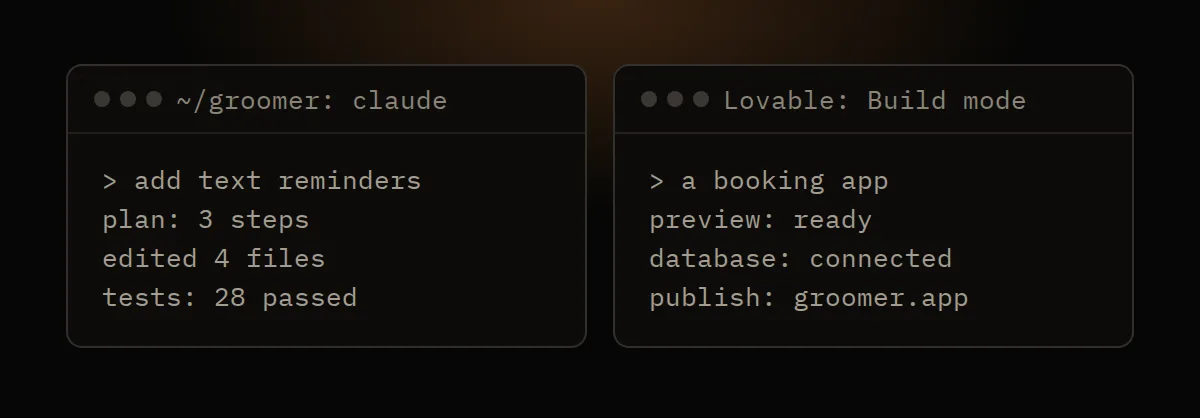
With Lovable, you type: a booking app for a dog groomer with online payments and reminders. A preview appears with a calendar, a booking form and a database. You ask for a different colour scheme, approve a plan for the payments, connect a custom domain and publish before lunch.
With Claude Code, you open the groomer's existing repository, ask Claude to add text reminders the day before each booking, approve its plan, watch it write the code and tests, and review the diff before deploying to the host you already use.
Watching several agents at once
Once an app outgrows its first version, the work often spreads across several Claude Code and Codex sessions. 10u shows every session side by side under the goal it's working toward, marks the ones waiting on you, and lets you answer from one screen on your laptop or phone.

Questions people ask
- What is the difference between Claude Code and Lovable?
- Claude Code is Anthropic's coding agent, working inside any codebase. Lovable is a chat-to-app builder that generates and hosts full-stack web apps from plain-language descriptions.
- Is Lovable better than Claude Code for beginners?
- For a web app with no setup, yes: Lovable includes hosting, a database and sign-in. Claude Code suits people comfortable with a terminal or editor, and covers far more kinds of software.
- Can I move a Lovable app to Claude Code?
- Yes. Turn on two-way Git sync with GitHub, GitLab or Bitbucket, clone the repository and work on it with Claude Code; changes sync back to Lovable.
- Can Claude Code control Lovable?
- Yes. Add Lovable's MCP server to Claude Code and it can create projects, send messages to Lovable, inspect code and deploy.
- Is Lovable free?
- Lovable has a free plan with no credit card needed. Pro was US$25 a month with 100 credits on 23 November 2026.