
Claude Code for founders: build the MVP, run the business and stay in control
Claude Code for founders is the closest thing to a first engineering hire you can start using today. Startup founders use it to build an MVP from a description, fix bugs, ship features, write the marketing site and automate the operations work that piles up before there's anyone to hand it to. Technical founders use it to move several times faster. Non technical founders use it to build things they would otherwise have paid an agency for or waited months to hire for.
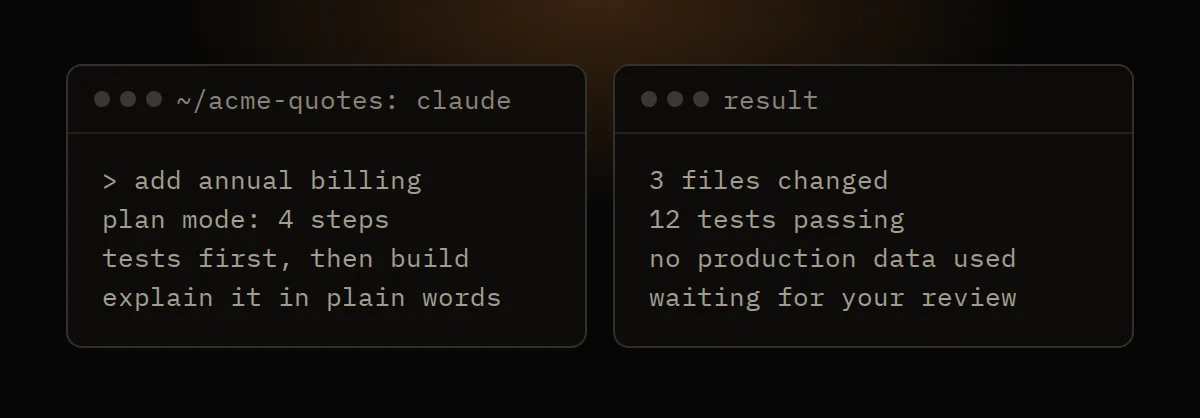
This guide covers what founders actually use Claude Code for, how to set it up so the codebase stays healthy, the skills that turn weekly chores into one command, what it costs, the risks that matter at an early stage and how to run several agents without losing track. Plan and feature details come from Anthropic's documentation, read on 23 November 2026.
Why founders are using Claude Code
Early-stage startups are short on time, money and people, and long on work that needs doing. Claude Code is an agent rather than a chat assistant: it reads your whole project, writes and edits files, runs the code and tests, and keeps going until a task is done. That makes it useful for the full spread of founder work, not just writing code.
Anthropic's account of how its own teams use Claude Code puts it well: agentic coding is dissolving the boundary between technical and non-technical work, turning anyone who can describe a problem into someone who can build a solution. For a founder, that means the bottleneck moves from who can build this to what should we build, which is the question you should be spending your time on anyway.
Source: How Anthropic teams use Claude Code, Anthropic
| Founder job | Without an agent | With Claude Code |
|---|---|---|
| Build the first version | Learn to code, hire, or pay an agency | Describe it, review it, ship it in days |
| Fix a customer's bug | Wait for a developer | Reproduce, fix and test in one session |
| Marketing site and landing pages | A website builder or a freelancer | Built in code, fast and fully yours |
| Weekly metrics | Spreadsheets by hand | One command that reads the exports |
| Customer research | Notes nobody rereads | Themes and quotes from every call and ticket |
| Investor update | Half a day of writing | A draft from the week's real numbers |
Technical and non technical founders
If you can code
Treat Claude Code as a fast, tireless engineer who needs clear direction and review. Spend your time on architecture, product decisions and reviewing changes, and let it do the implementation, tests, migrations and the dozens of small fixes that eat a week. The biggest gains come from running more than one task at once and from writing down your standards in CLAUDE.md so you stop repeating them.
If you can't code
You can still build real software, but your job changes from writing code to directing and checking it. The Claude desktop app has Claude Code built into its Code tab, so you don't need the terminal: pick a folder, describe what you want, review each change as a before and after. Insist on tests, ask it to explain every change in plain words, and get an experienced engineer to review the codebase before you handle payments or sensitive customer data at any scale.
Source: Get started with the desktop app, Claude Code docs
What founders build and run with Claude Code
The MVP
Start with the smallest version that tests your riskiest assumption. Describe the users, the one job they need done and the screens involved, ask Claude Code for a plan in plan mode, cut anything that isn't essential, then let it build. Ask it to choose boring, well-documented technology, because that's what it, and any engineer you hire later, will handle best.
Features and fixes from customer feedback
When a customer reports a problem, paste their message in, ask Claude to reproduce the issue, write a test that fails, fix it and show you the test passing. When several customers ask for the same feature, describe it, agree a plan, and ship it the same week. Speed of response is one of the few advantages a small startup has over a big one.
The marketing website
A founder can build a fast, good-looking marketing site in code with Claude Code: home page, pricing page, comparison pages and a blog. Because it's code you own, there's no per-page builder fee and every page can be tuned for search. Keep the site in its own folder so marketing changes never risk the product.
Operations and internal tools
Most early-stage operations are spreadsheets and copy-paste: monthly invoices, onboarding emails, usage reports, CRM clean-ups. Claude Code can build small scripts and internal tools for each one. Anthropic's write-up describes non-engineering teams across the company building their own automation that would otherwise need dedicated developers or expensive software.
Customer and market research
Put call notes, support tickets and survey exports in a folder and ask for recurring problems, how many customers raised each and the strongest quotes, with the source file for each. Do the same with competitors' pricing pages and changelogs to keep a living competitive brief.
Pricing strategy and analysis
Claude Code can't tell you what to charge, but it can do the analysis around the decision: model revenue under different tiers from your usage export, show which customers would pay more or less under a change, and summarise how competitors package and price similar plans. You make the pricing strategy call with the numbers in front of you.
Set it up so the codebase stays healthy
The risk for founders isn't that Claude Code can't build things. It's that it builds things quickly in a way that becomes hard to change. A little structure at the start prevents that.
- Use git from day one, so every change is saved and can be undone. Claude can set it up and explain it.
- Ask for tests with every change, and for Claude to run them before saying a task is done.
- Keep a CLAUDE.md with the company context, the folder layout and the rules, so every session starts with the same understanding.
- Use plan mode before any feature bigger than a small fix, and read the plan before letting it build.
- Keep secrets such as API keys out of the code. Ask Claude where they should go and how to keep them out of version control.
- Keep permission prompts on for anything that touches production, payments or customer email.
# CLAUDE.md

## The company
Acme Quotes: online quoting for small trades businesses.
Customers: plumbers and electricians with 1-10 staff.
Stage: 40 paying customers, founder-led, no employees yet.

## This repo
app/        the product (Next.js, Postgres)
site/       the marketing website
ops/        scripts for reports, invoices and customer emails
docs/       strategy.md, pricing.md, customers.md

## Rules
- Explain what you change in plain words. I am not an engineer.
- Never touch production data or send email without asking me.
- Every change to app/ needs tests, and must pass them before you finish.
- Never put keys or passwords in files. Ask me where secrets go.
Source: Memory and CLAUDE.md, Claude Code docs
Claude skills: turn weekly chores into one command
A skill is a saved set of instructions Claude Code follows whenever you ask for that job. Founders repeat the same chores every week, which makes them perfect skills. Write each one once, improve it whenever the result isn't quite right, and the work gets faster every week. A typical founder week might look like this.
Monday   /weekly-metrics       revenue, signups, churn from the exports
Monday   /customer-themes      what support tickets said this week
Tuesday  build the top fix     plan mode first, then tests, then build
Thursday /release-notes        what changed, written for customers
Friday   /investor-update      draft from metrics and release notes
Good first Claude skills for startup founders include a weekly metrics skill that always reads the same exports and reports the same numbers, a customer themes skill that counts how often each problem appears, a release notes skill written for customers rather than engineers, and an investor update skill that drafts from real numbers and never invents progress.
Source: Skills, Claude Code docs
What it costs
Claude Code needs a paid Claude plan. On 23 November 2026, Pro was US$17 a month billed annually or US$20 monthly; Max was US$100 a month for five times Pro's usage; Ultra was US$200 a month for ten times Pro's weekly usage. Most founders start on Pro and move up only once they're using it for hours every day. Compared with an agency quote or a first engineering salary, the subscription is rarely the cost that matters.
The real cost is your attention: reviewing changes, answering questions and deciding what to build next. That's why the setup above and the habits below matter more than which plan you choose.
Source: Claude plans and pricing, Anthropic
Risks founders should take seriously
- Security. Authentication, payments and customer data are where mistakes cost most. Use well-known services for login and payments, ask Claude to review security on every change, and get an expert review before you scale.
- Hidden complexity. Code that works today can be hard to change tomorrow. Ask Claude to keep things simple and to explain the design in plain words.
- Unreviewed changes. Never let an agent push to production without you reading what changed and the tests passing.
- Confident mistakes. Check any number, claim or legal statement Claude produces before it goes to a customer or an investor.
- Single point of knowledge. If only the agent understands the code, write down how things work in docs/ as you go. Claude can do the writing.
Running several agents as a founder
Founders get the most out of Claude Code when several tasks run in parallel: a feature in one session, a bug fix in another, the marketing site in a third and the weekly metrics in a fourth. Anthropic's permission modes, including auto mode, let longer tasks run with fewer interruptions while risky actions are still blocked. But every session still stops sometimes to ask a question, and a founder's day is already full of interruptions.
Source: Permission modes, Claude Code docs
10u is the control room built for this. It shows every Claude Code and Codex agent side by side under the goal it's working toward, marks the ones waiting on you, and lets you answer from one screen on your laptop or your phone, whether you're between calls or away from your desk. Your agents keep running where they are; 10u shows you which one needs you next.
When to bring in a human engineer
Claude Code changes when you need your first engineering hire, but it doesn't remove the need. Bring in an experienced engineer, even for a few days of review, when any of these become true: you're about to take payments or store sensitive customer data at scale, the product has paying customers who would be badly hurt by an outage, changes that used to take an hour now take a day because the code has become tangled, or you're spending more time reviewing agent output than talking to customers. A good engineer working alongside Claude Code is far more productive than either alone, and your CLAUDE.md, skills and docs/ folder become their onboarding pack on day one.
Mistakes startup founders make
- Building for weeks before showing a single customer.
- Asking for the whole product in one prompt instead of one small, testable piece at a time.
- Skipping tests and version history because the first version is just an experiment.
- Letting the codebase grow with no CLAUDE.md, so every session rediscovers the same rules.
- Handling payments or sensitive data with no expert review.
- Spending the time saved on building more features instead of talking to customers.
A first week for founders
- Day 1: install Claude Code or open the desktop app's Code tab, create a repo with git and write a short CLAUDE.md about the company.
- Day 2: in plan mode, describe the smallest version of the product that tests your riskiest assumption. Cut the plan down.
- Day 3: build it, with tests, and run it yourself.
- Day 4: show it to three potential customers and write down what they said.
- Day 5: put their feedback in a folder and ask for themes, then fix the top problem.
- Day 6: write your first two skills: weekly metrics and customer themes.
- Day 7: decide what to build next week from what customers said, not from what's easiest to build.

Questions people ask
- Can a non technical founder build an MVP with Claude Code?
- Yes. You describe the product in plain words, review each change and test the result, and the desktop app's Code tab means no terminal. Get an experienced engineer to review security before handling payments or sensitive data at scale.
- What do founders use Claude Code for besides coding?
- Marketing sites, internal tools, weekly metrics, customer research synthesis, pricing analysis, release notes and investor update drafts.
- How much does Claude Code cost for a founder?
- It needs a paid Claude plan. On 23 November 2026 Pro was US$17 a month billed annually or US$20 monthly, Max US$100 a month and Ultra US$200 a month.
- Is Claude Code a replacement for a technical co-founder?
- It can do much of the building, but not the judgement. A founder still needs to decide what to build, review changes and get expert help on security and architecture as the company grows.
- What are Claude skills for founders?
- Saved instructions Claude Code follows for a repeated job, such as weekly metrics, customer themes, release notes or an investor update, so a chore becomes one command.
- How do I keep a startup codebase healthy with Claude Code?
- Use git from day one, require tests with every change, keep a CLAUDE.md with context and rules, plan before big features and keep secrets out of the code.